Showing posts with label Apricot tree. Show all posts

Saturday, July 30, 2011

CC & R Farm fruit trees

The fruit trees are doing great!  We've been pruing them each year using the skills we learned from the UNR Cooperative Extension Master Gardener tree guy, Michael Janek, and our local permaculture group.  They're all between 3-5 feet tall and filling out nicely.


This is the Meteor sour cherry tree.  It arrived a scrawny bareroot; we whipped it according to instructions even though it was really scary to cut off the branches.  The poor thing was little more than a stick when we put it in the ground in 2009.  We were sure it was going to die but removing the wood so the tree would focus on root development really paid off.  It's beautiful.  We hope for fruit in about 2 years.
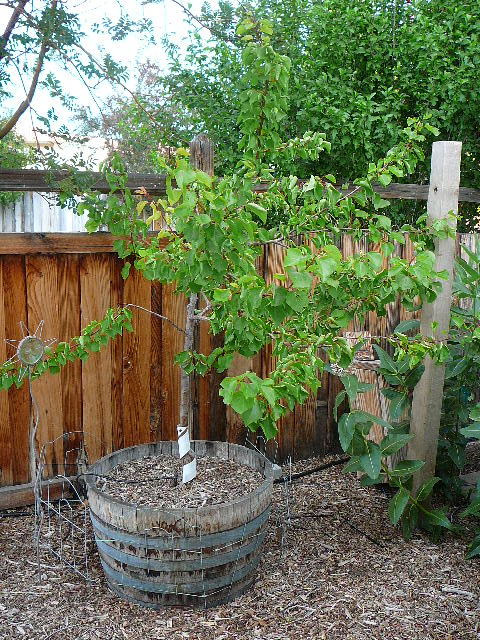


This is the genetically altered apricot tree with the icky name....15MA522. It is also doing well. We purchased genetically modified because we needed a small apricot tree that would grow in a pot. Apricots can grow in northern Nevada but the climate must be right; we figured there must be a suiteable microclimate someplace in our yard, so we planted it in a pot to make it easy to relocate. Until spring 2011 it was located close to the house and the warmth from the siding caused the tree to blossom too early -- we lost the blossoms in two or three subsequent frosts. We're hoping this spot is cooler so the tree will blossom later next year.


This was a mistake!  In 2009 we planted asclepias for the butterflies.  The seedlings where so puny I didn't really think they'd survive so I positioned them in front of the espaliered Calville Blanc d'Hiver apple tree.  The asclepias grew well in 2010.  This year it took off sending up shoots all over the place!  It is now taller than the apple tree and is undoubtedly winning the competition for nutrients and sunlight.  Next year we'll leave the runners that sprout behind the tree and remove them from the front. 

The Reliance peach tree is beautiful.  It also developed blossoms this year but the frost got 'em.  We'll try coving it with Agribon in spring of 2012 to protect the blossoms.


And finally -- the Newtown Pippin apple.  I really expected this one to develop some fruit this year because apple trees are supposed to produce within a year or two of planting.  My friend Leslie had fruit the second year.  This tree has been in the ground three years. What gives!  The good news is the traps did catch a single coddling moth.


Friday, November 28, 2008

Apricot trees

WE ORDERED (arrived bare root on 2/16/09) :

*Genetic dwarf apricot named 15MA522 (icky), compact tree, estimated required 600 chill hours,

*Nemaguard peach rootstock, vigorous, resistant to root-knot nematode, unpruned tree height of standard varieties 15-25 ft, but trees on this stock can be held to any height with summer pruning.

*Will plant in a used 1/2 wine barrel purchased at Raley's.

Apricots more closely related to plums than peaches; most are self-fertile

Fruit buds are normally produced on spurs that fruit for two to four years and on the tips of last season’s shoot growth; pruning has been shown to be the best way to reduce competition among excess fruit.

Apricot trees are large and sturdy; fruit buds similar in hardiness to peach but quite susceptible to drying by cold winter winds, consequently apricots produce best if grown in a sheltered spot in the landscape.

Earliest fruit tree to flower in the spring; best trained to modified central leader system; trees should be pruned lightly in their early years, just enough to develop a sufficient scaffold structure; in northern regions you may want to postpone pruning until after bloom and spring frosts so you can tailor your pruning severity somewhat to the amount of crop you can anticipate; direct much of the pruning of the mature tree to keep in contained to the height and width practical for your garden

Rootstock
Myrobalan (plum rootstock) is very well adapted to heavy, wet soils; produces well anchored standard size tree.


Varieties adapted to the Pacific coast – Blenheim, Goldbar, Goldrich, Goldstrike, Moorpark, Perfection, Puget Sound, Rival, Tomcot, Wenatchee

Low chill apricots – Earligold, Garden Annie (600), Newcastle (350), Perfection (600)

Average years to bearing – 4-5 years
Average yield per tree – 50 to 100 pounds
Space needed per tree – 20 foot circle
Average mature height – 20+ feet
Days from bloom to harvest – 80 to 90 days
Pollination requirements – many are self-fruitful, but produce better with cross pollination
Most common pruning system – modified central leader
Commonly used rootstock – Apricot seedling or Myrobalan (plum rootstock)
Common insect pests – Curculio, oriental fruit moth
Common diseases – Brown rot
Useful life – 12 + years
Number of trees for a family of four – 1 to 2 trees
Bears fruit on 2 to 4 year old spurs and tips of new growth


Moorpark (England 1760)

Tilton
Resistant to late frost; purportedly one of the best tasting; approximate harvest date July 1 to July 10; 600 chill hours; widely adapted; semi-dwarf stock from Peaceful Valley

Harcot
Approx harvest date June 5 to June 15th; 700 chill hours; frost hardy; late blooming; resists brow rot and perennial canker; very tasty; semi-dwarf stock from Peaceful Valley

Chinese Apricot
 
Copyright 2009 CC&R Farm. Powered by Blogger
Blogger Templates created by Deluxe Templates
Wordpress by Wpthemescreator
Blogger Showcase